|

|
|
 |
||
|
|
|
|
|
|
||
Rema Vlasova, Leading Researcher, Professor |
Victor Semkin, Senior Researcher |
Boris Petrov, Junior Scientist |
|
We investigate organic conducting molecular crystals (ion-radical salts of organic donor or acceptor molecules and respective ions), which attract a lot of attention (especially in the last twenty years) due to their unique electronic properties: high one- or two-dimensional anisotropy of the conducting electronic system, unusual electron-phonon phenomena, high electronic correlations, electronic phase transitions of various nature, in particular a competition between insulating and superconducting state.
We studied the low-diemesional organic conductors based on
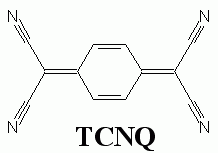
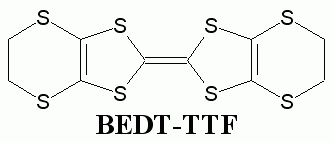
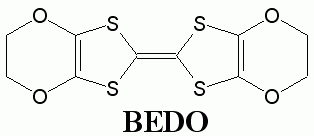
tetracianohinodimethane (TCNQ), bis (ethylenedithio) tetrathiafulvalene (BEDT-TTF) and related molecules : bis (ethylenedioxy) tetrathiafulvalene
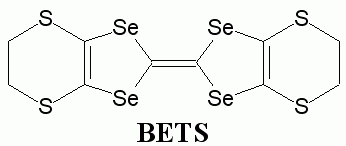
(BEDO-TTF) и bis(ethylenedithio)tetraselenafulvalene (BETS).
Aim of the research 1. Measurements of the reflectivity spectra R(w) of the monocrystals in the different crystal faces.
2. Obtaining the spectra of optical conductivity and
dielectric constant by Kramers-Kronig relations.
3. Analysis of the received spectra on the base of the new «cluster
model»,
which regards the electronic correlations in the Hubbard
approximation and takes into account interactions of electrons with
the intramolecular vibrations, as well as on the phenomenological
Drude and Drude-Lorentz models. It reveals the nature of the optical
electronic transitions and helps to obtain the constants and
parameters of the models.
4. Investigation of the nature of the electronic phase
transitions and their influence on the optical properties.
Equipment Polarized reflectivity spectra at the normal light incidence in the
spectral range of 600-6500 cm-1 are measured using FT IR
Perkin-Elmer 1725X
spectrometer,
equipped with a microscope with MCT-detector. Diameter of the light-probe is 100
mm,
resolution 2 cm-1, golden wire polarizer. For the
low-temperature measurements an Oxford continiuous flow
cryostat was used.
In the spectral range between 9000 and 40000 cm-1 the
spectra are measured using two-beams microspectroreflectometer
developed in Vavilov State Optical Institute; the probe beam
diameter is 25
mm, resolution 60 cm-1, Glan-Thomson prism as a polarizer. The
control of quality of the surface and orientation of the crystal in
the beam is performed by an obtaining a visual picture at the
microscope.
TCNQ, BEDT-TTF, BEDO-TTF, BETS structures
Synthetic chemistry gives a possibility to vary electronic
properties of these materials in wide ranges. In present the
low-dimensional organic metals with the unique properties,
superconductors (Tc= 11.6 K) and semiconductors are obtained.
In our laboratory we carry out the optical investigations in the
polarized light of the single crystals of the organic conductors
and superconductors based on various related organic molecules
of different crystals structure. The measurements are done for
the perfect quality single crystals using microscopic technique
in the spectral ranges between 600 and 6000 cm-1 at
temperatures between 10 K and 300 K and in the 9000-40000 cm-1 spectral
range at room temperature.
The synthesis of the compounds is done in the Institute of
problems of Chemical Physics (laboratories of Prof. R. N.
Lyubovskaya and E.B. Yagubskii) and in the Natural Science
Institute of Perm State University (Dr. of Science G.G.Abashev).
Measurements using FT IR spectrometers are performed in
cooperation with the Institute of High-Molecular Compounds
(laboratory of Dr. Volchek B.Z.) and Institute of Molecular
Physics PAN, Poznan, Poland (laboratory of Prof. Graja A.). Theoretical treatment of the obtained
results is performed together with Prof. Yartsev V. M. (London,
Canada).
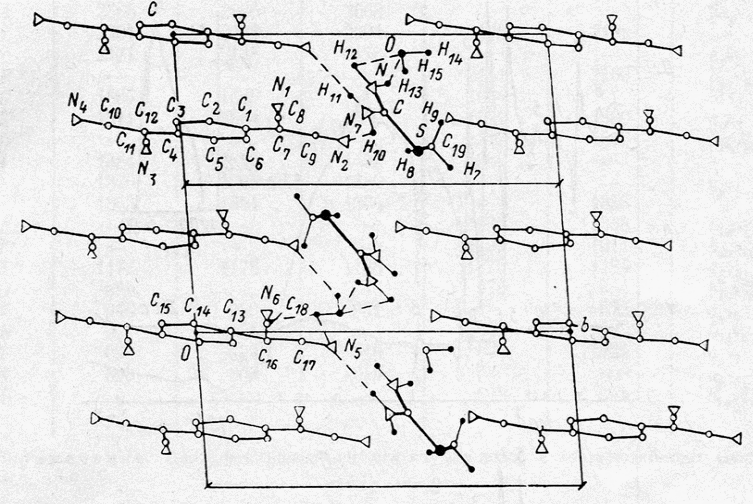
The crystal structure of the studied quasi-one-dimensional compounds (an example
is semiconducting МТ2TCNQ3)
consists of the stacks of the anion molecules TCNQ spaced by
the cations (МТ2)
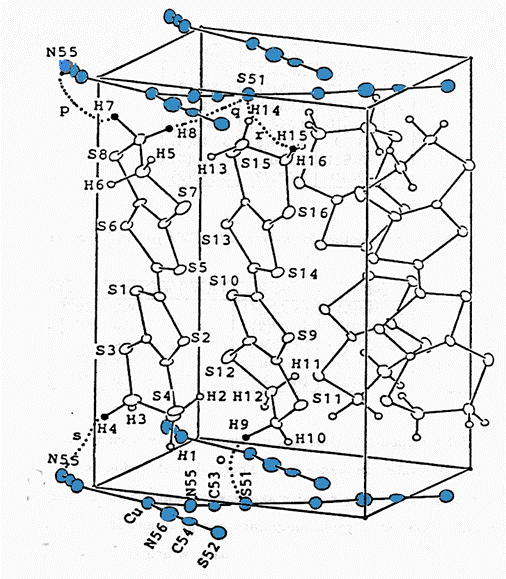
The crystal structure
of quasi-two-dimensional crystals consists of the layers
of molecules BEDT-TTF (cation-radicals) or related
molecules, spaced by the anion layers.
Crystal srtucture of the
organic
superconductor
k-BEDT-TTF2Cu(CSN)2
(H.Urayama et al.
Chem.Lett. 1988, 1159
(1988))
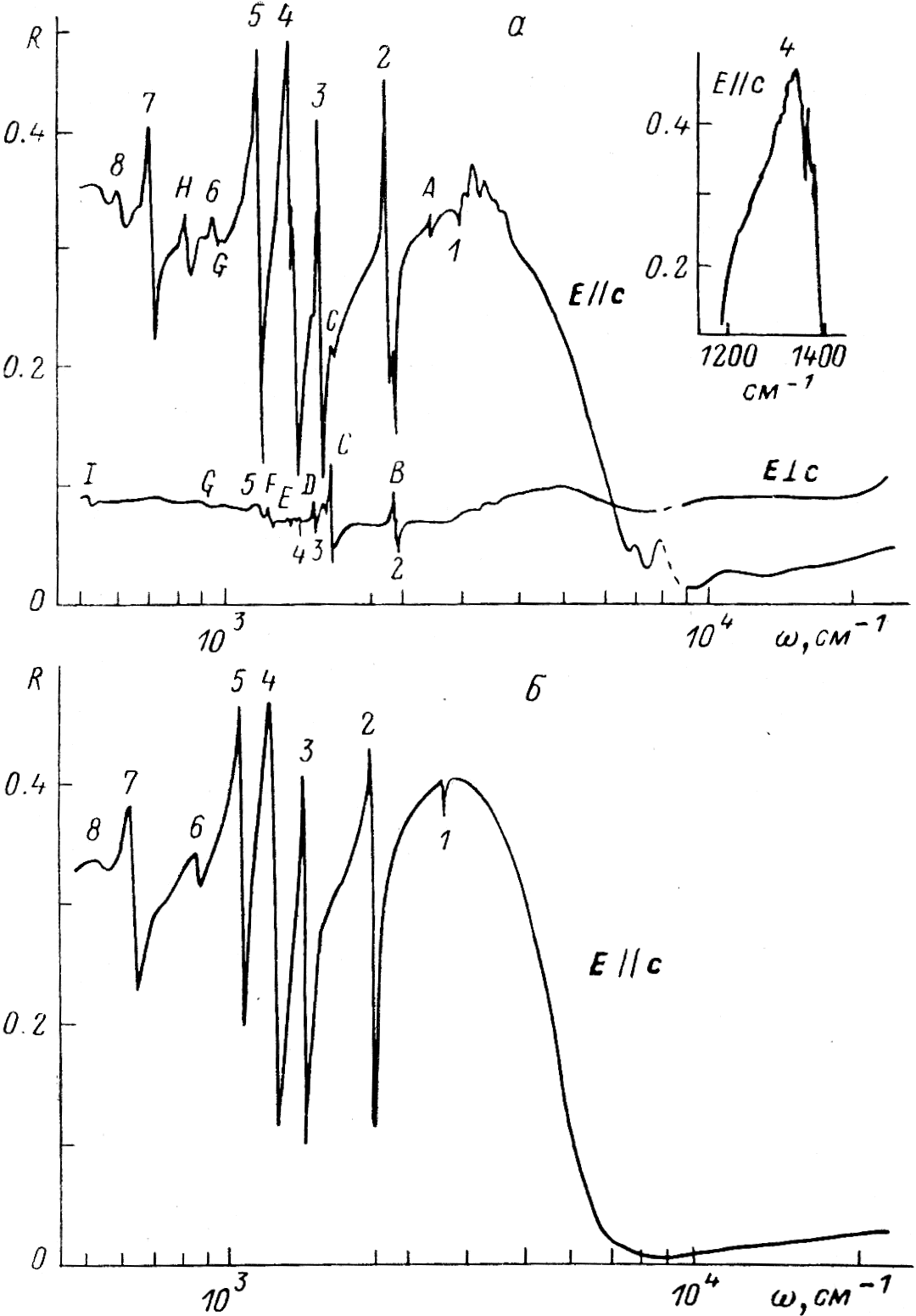
Reflectivity spectra of
МТ2TCNQ3*2H2O single crystals
measured in the polarizations, where electrical field E of the incident light is parallel and perpendicular to the stacks direction (E || c и E ^ c).
a- experiment results
б - theoretical
calculation for E ||c
A high anisotropy of the reflectance spectra and electron-phonon interaction are
observed.
(V.N.Semkin, R.M.Vlasova,
N.F.Kartenko et al
Sov.Phys.Solid State 31 (8) 1989
pp.1327-1333)
For the crystals
(BEDO-TTF)5[CsHg(SCN)4]2 the
optical spectra were studied at temperatures between 300 and 15
K. At 300 K a
quasi-two-dimensional character of the electronic system was
shown.
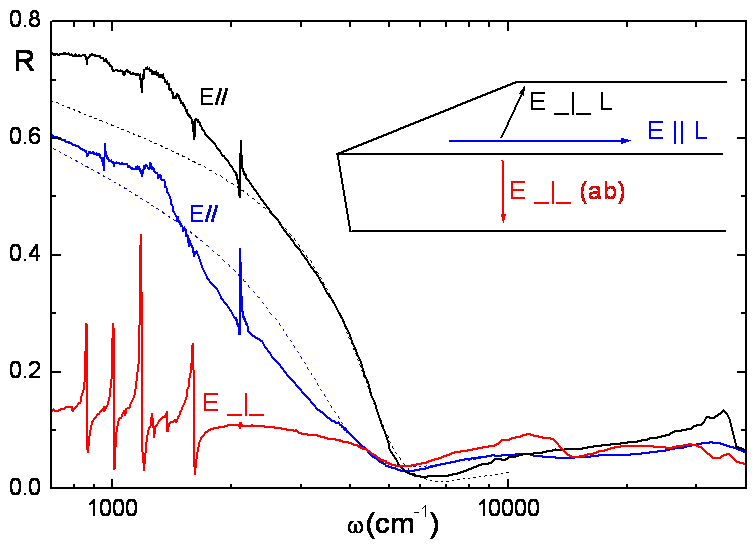
For the polarization parallel to the layers of BEDO-TTF molecules spectra (1 and 2) show metallic character. For the polarization perpendicular to the layers the spectrum (3)
is typical of a molecular insulator. Basing on the calculations of the zone structure of the related compound (superconductor) based on the same molecule, we concluded that the studied material is a
quasi-two-dimensional semi-metal with the overlapping electronic bands. By a fit of the spectra with a Drude model (dashed line) the parameters of electronic system and the bandwidth were defined. It was shown,
that the allowed electronic bands are more narrow than that of the related superconductor. The assignment of vibrational featurs observed in the spectra to the normal vibrations of BEDO-TTF was made for the three
investigated polarizations.
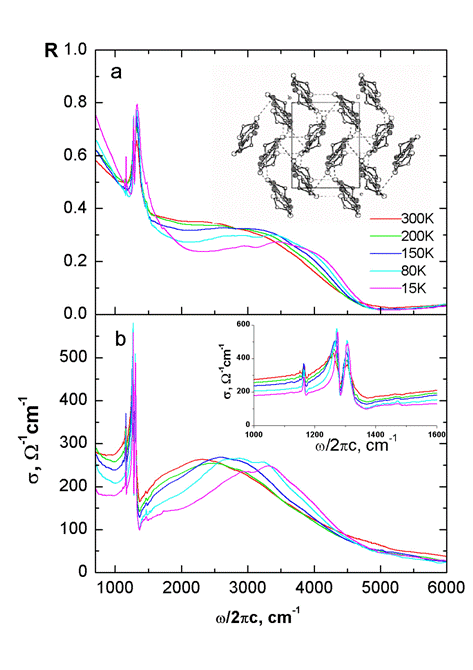
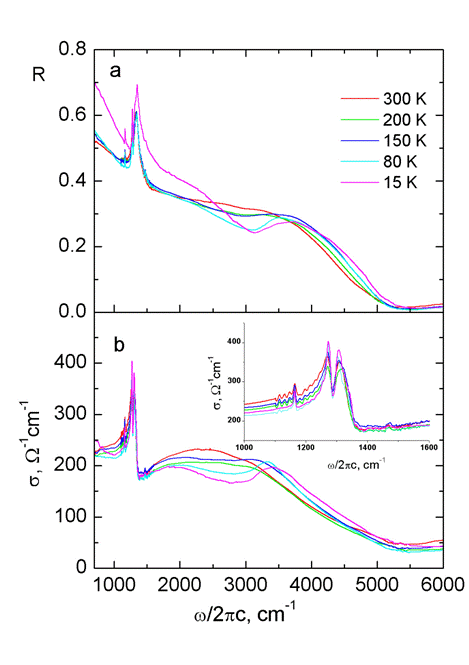
We performed a comparative optical study of new organic conductors,
a superconducting k-(BETS)4Hg2.84Br8 (Tc=2 K) and a metal with
a transition to insulating state to 35 K k-(BETS)4Hg3
Cl8 The infrared
spectra were measured in 300-15 K temperature range. At room
temperature the spectra of these two compounds are very similar and
deviate from the Drude behavior; this is typical for the crystals of k-phase. |
|
superconductor k-(BETS)4Hg2.84Br8
|
metal k-(BETS)4Hg3
Cl8 |
|
The figure shows that at the temperature decrease the different changes occur in the spectra of the superconductor and the metal.
In the spectra of the metallic compound at Т < 150 K a splitting of the wide electronic infrared maximum is observed. Simultaneously a splitting of
the electron-vibrational feature of the n3(Ag) vibration of BETS molecule occurs. These changes point on an electronic phase transition and lowering of the crystal
symmetry. No similar changes are observed in the spectra of the superconductor.
R.M. Vlasova, N.V. Drichko, B.V. Petrov et al.
Electron and electron - phonon effects in quasi-twodimensional molecular
conductor Θ-(BETS)4HgBr4(C6H5Cl), optical studies at
300 - 15 K// Phys. Solid State, (2002) 44, p.8-15.
N.V.Drichko, R.M.Vlasova, V.N.Semkin et al.
Electronic properties of new quasi-two-dimensional organic conductors
(BEDO-TTF)5[MHg(SCN)4]2 (M=Rb,Cs) studied by IR reflectance spectroscopy
at temperatures down 10K // Phys.stat.sol. (b) 236. No. 3, pp.668-677, (2003).
R. M. Vlasova, N. V. Drichko, B. V. Petrov et al.
Optical Properties of New Organic Conductors Based on the BEDT-TSeF
Molecule (the -(BETS)4Hg2.84Br8 Superconductor
and -(BETS)4Hg3Cl8 Metal) in the Range 300–15 K //
Phys. Solid State, (2004) 46, p. 1985-1993.
M.Dressel, N.Drichko //Chem.Rev. Nov. 2004,104, pp.5689-5715.
Web-Master |