



Andrey Georgievich Zabrodskii
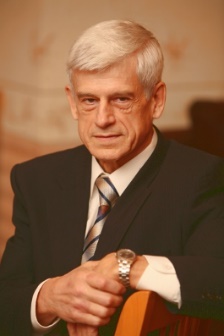
Director of the Institute from 2003 to 2018.
Born on June 26, 1946, in Kherson. A.G. Zabrodskii's scientific career is entirely connected with the Ioffe Institute, where he progressed through all stages: from postgraduate student to laboratory head (1989–2017), deputy director (1998–2003), and director (2003–2018). Under the leadership and with the participation of A.G. Zabrodskii, a number of projects significant for the Institute's development were carried out. These include a cycle of research and development in the field of hydrogen energy within the framework of the "RAS-Norilsk Nickel" Program, which led to the creation of efficient compact current sources based on air-hydrogen fuel cell technologies developed in the Ioffe Institute's laboratories. The Ioffe Institute participated in a large-scale solar energy development project as part of a research and production consortium alongside the Hevel Scientific and Technical Center, established on its premises in 2012 to develop industrial technologies and staffed with scientific personnel with the Institute's help. The project resulted in the creation of a new sub-sector of the country's energy industry – solar energy based on silicon heterostructures. A.G. Zabrodskii initiated and, until 2018, led the implementation of a major investment project to establish an R&D center at the Ioffe Institute for the development of advanced heterostructure technologies and the country's high-tech complex. Resolving issues related to the project often required engagement at the highest level of state authority. A.G. Zabrodskii organized and led the direction "Physics for Life Sciences," involving scientists from St. Petersburg institutions conducting research and developing approaches, methods, materials, technologies, and devices for medicine and biology. From 1993 to 2003, A.G. Zabrodskii taught the general physics course at St. Petersburg State Polytechnic University and conducted an elective seminar on topics beyond the curriculum. Several participants of these seminars are now among the leading researchers at the Ioffe Institute. Since 2006, A.G. has headed the basic department he founded at St. Petersburg State Electrotechnical University (LETI). Under his leadership in 1996, the annual International Winter Schools of the Ioffe Institute on Semiconductor Physics were revived. A.G. devotes considerable effort to scientific publishing, serving as Editor-in-Chief of the *Journal of Technical Physics*, Chairman of the Ioffe Institute Scientific Publishing Council, and a member of the RAS Scientific Publishing Council. In 2008, A.G. Zabrodskii was elected a Corresponding Member, and in 2013, a Full Member of the Russian Academy of Sciences (RAS). He is a member of the RAS Presidium and the Bureau of the RAS Department of Physical Sciences. He is a laureate of the USSR Council of Ministers Prize (1983) and the Russian Federation Government Prize (2018) in Science and Technology. He has been awarded the Order of Honor and the Medal "In Commemoration of the 300th Anniversary of St. Petersburg."
Zhores Ivanovich Alferov (1930-2019)
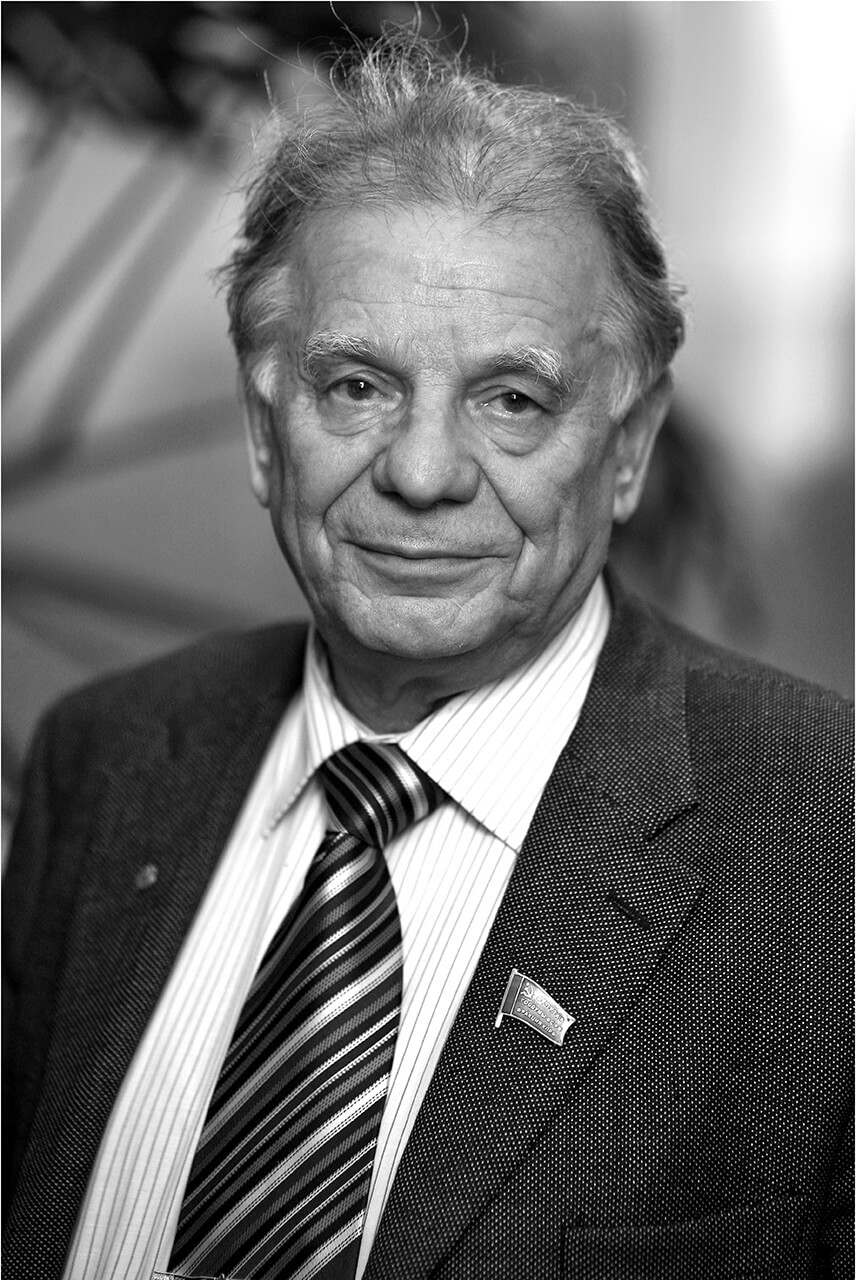
Director of the Institute from 1987 to 2003.
Born on March 15, 1930, in Vitebsk (now Republic of Belarus). In 1952, he graduated from the Faculty of Electronic Engineering of the V.I. Ulyanov (Lenin) Leningrad Electrotechnical Institute. In 1953, he joined the Ioffe Institute, where he defended his Candidate (1961) and Doctoral (1970) dissertations. He became a Corresponding Member (1972) and Full Member (1979) of the USSR Academy of Sciences (now RAS). He was awarded the Nobel Prize in Physics (2000). He was a leading specialist in the fields of semiconductor physics, semiconductor electronics, and quantum electronics. He participated in the creation of the first Soviet transistors, photodiodes, and high-power germanium rectifiers. He demonstrated that in semiconductor heterostructures, electron and light fluxes could be controlled in a fundamentally new and efficient way. He created ideal semiconductor heterostructures. He was the founder of a scientific school that established a new direction – heterojunctions in semiconductors. In 2000, together with H. Kroemer, he was awarded the Nobel Prize in Physics for "fundamental work that laid the foundations of modern information technology through the creation of semiconductor heterostructures used in high-frequency and optical electronics." Among his numerous international and national awards and honors are the Lenin Prize (1972) and the USSR State Prize (1984), the Russian Federation State Prize (2001), the Kyoto Prize (2001), and the Global Energy Prize (2005). He was an honorary member of several foreign academies and societies and an honorary doctor of many universities and institutes. For many years, he carried out extensive scientific organizational work as Vice-President of the RAS and Chairman of the St. Petersburg Scientific Center of the RAS. He led the Scientific and Educational Center, which he organized on the basis of the Ioffe Institute in 1999. The Center became an independent RAS institution in 2004. He was the founder (2002) and leader of the Academic Physics and Technology University. From 1988, he was Dean of the Physics and Technology Faculty of St. Petersburg State Polytechnic University. He was Editor-in-Chief of the journal *Technical Physics Letters*. He was widely known for his socio-political activities. From 1995, he was a Deputy of the State Duma of the Russian Federation, a member of the Duma Committee on Science and Education from 2000, and a member of the Duma Committee on Science and High Technologies from 2007. After being awarded the Nobel Prize, he founded the charitable Foundation for the Support of Education and Science (Alferov Foundation).
Vladimir Maksimovich Tuchkevich (1904–1997)
Director of the Institute from 1967 по 1987
Born on December 29, 1904, in Yanoutsy (Ukraine). In 1928, he graduated from Kyiv University. Starting in 1935, he worked at the Ioffe Institute. He defended his Doctoral dissertation in Physical and Mathematical Sciences in 1955 at the Ioffe Institute. He became a Corresponding Member (1968) and Full Member (1970) of the USSR Academy of Sciences (now RAS). He was named a Hero of Socialist Labor (1984).
His early work was related to the physics of X-rays. During the war years, he was a participant and organizer of work on mine protection for Navy ships. In the early post-war years, he participated in work on isotope separation within the framework of the Soviet atomic project. His greatest contributions were in the field of semiconductor physics and technology: high-power semiconductor devices, the first Soviet planar transistor, thyristors, single crystals of pure germanium, germanium rectifiers with record parameters, etc. From 1936, he lectured at the Leningrad Polytechnic Institute (now St. Petersburg Polytechnic University) and, alongside his duties as director, supervised higher education organizations. Many of his students and colleagues became prominent physicists.
Among his numerous distinctions and awards: Stalin Prize (1942), Lenin Prize (1966), Gold Medal "For Merit in Science and Humanity" (Czechoslovak Academy of Sciences, 1977), Hero of Socialist Labor (1984).
He was Editor-in-Chief of the Journal of Technical Physics.